Self-Healing Workflows are now in StackAI, built for a problem every enterprise faces: agent quality that quietly slips while workflows keep running, until customers are the ones who notice. Now, when a model evaluation score drops below its threshold, StackAI identifies a fix and presents before-and-after results for approval, turning silent failures into resolved ones.
Key Takeaways
Self-Healing Workflows detect when an agent's evaluation score drops and automatically propose a fix.
Enterprises can now catch silent failures early. Teams still review the before-and-after result fixes, click Approve, and get back to running the core business.
StackAI's Evals and Monitors now form a complete quality loop: measure, monitor, and improve agents in one no-code AI platform.
The Importance of Measuring Agent Quality
AI agents are not deterministic. As inputs, documents, and models shift, the same workflow can perform well one day and fail the next. For enterprises, that is a business risk: a wrong claim decision or off-policy response can reach a customer before anyone notices.
That is why quality has to be measured continuously, not assumed. Teams need a clear standard: for a defined set of inputs, the agent returns outputs the business accepts, scored the same way every time.
StackAI’s Evals make that standard testable and actionable. Teams build datasets of inputs and expected outputs, choose evaluators that score each result against defined criteria, and run experiments that report pass rate, latency, and token usage for every workflow version. Monitors then apply the same scores to live runs and flag any drop below threshold.
But an alert only starts the work. Someone still has to dig through runs, find the cause, and revise the workflow while the issue persists.
StackAI Now Evaluates, Improves, and Verifies, With Humans in Control
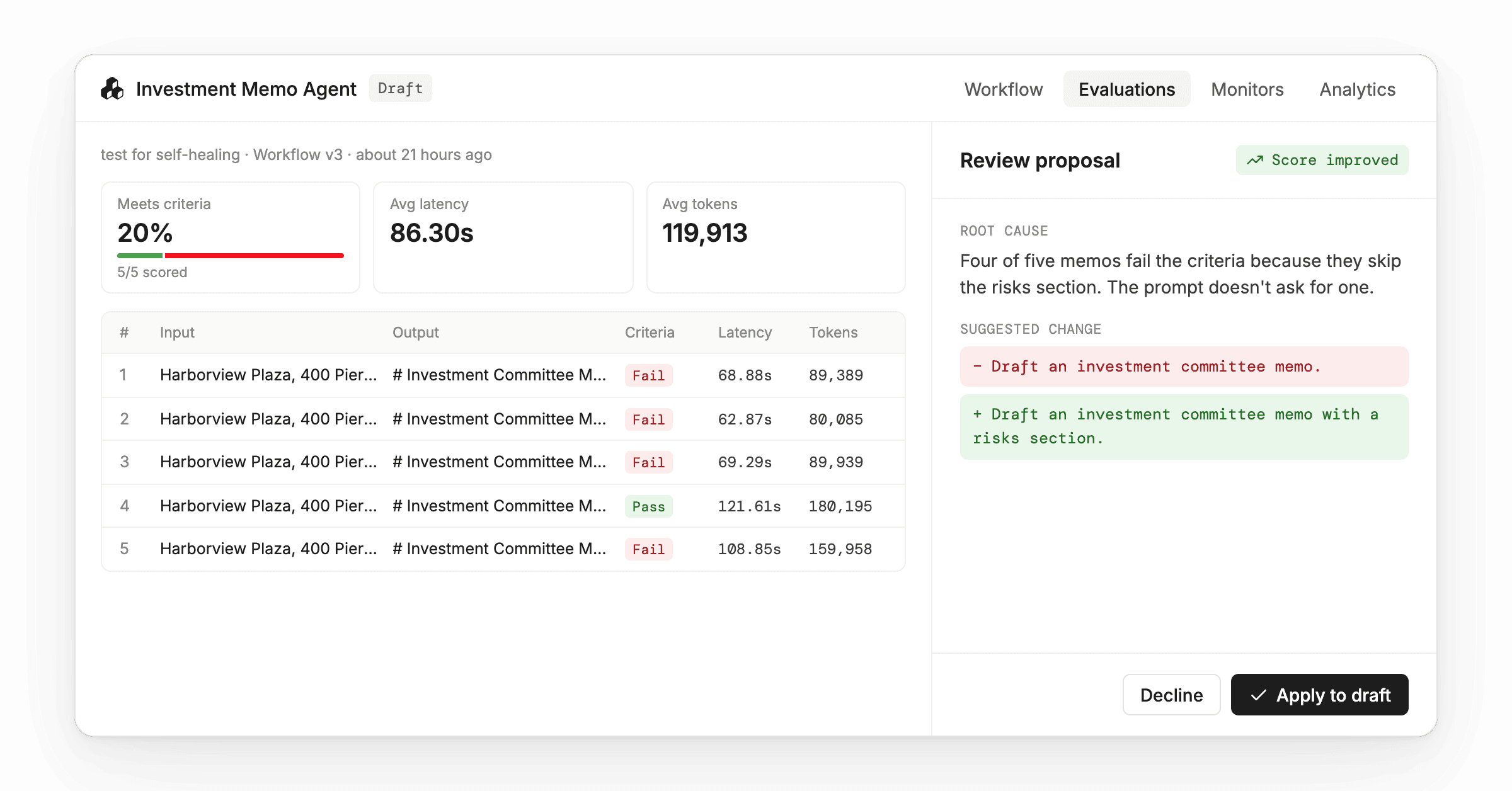
With Self-Healing Workflows, when a monitored score falls below its threshold, self-repairing starts automatically. Teams can also run the same loop manually from any experiment. It works by:
Evaluate. StackAI runs an experiment over a dataset and scores every output against the selected evaluators, surfacing the failing cases and the evaluator's reasoning for inspection.
Improve. It proposes a fix: a plain-language explanation of what to change and why, supporting analysis tied to the failing examples, and the exact differentiation. A line like "Answer using the policy docs" might become "Answer only from retrieved policy docs. If no source is found, say so."
Verify. The fix is applied to a draft, never directly to production. The evaluation reruns against the draft so scores can be compared before and after. Once the results hold, your team approves the change.
Suggestions arrive automatically, but approval always stays with your team. The result is less time spent de-bugging and more time spent running the core business.
Get the Best Possible Output From Every Agent
The best agents are the most rigorously tested. With StackAI Evals, experiments show exactly how every prompt, model, or workflow change performs against a defined standard. In production, monitors track that standard on live runs, and Self-Healing Workflows step in when it slips, catching drift and restoring quality before customers ever feel it.
See how StackAI Evals and Self-Healing Workflows deliver higher-quality agent outputs. Request a demo here.

Esther Na
Product Marketing at StackAI


